
 By Song Jingwoo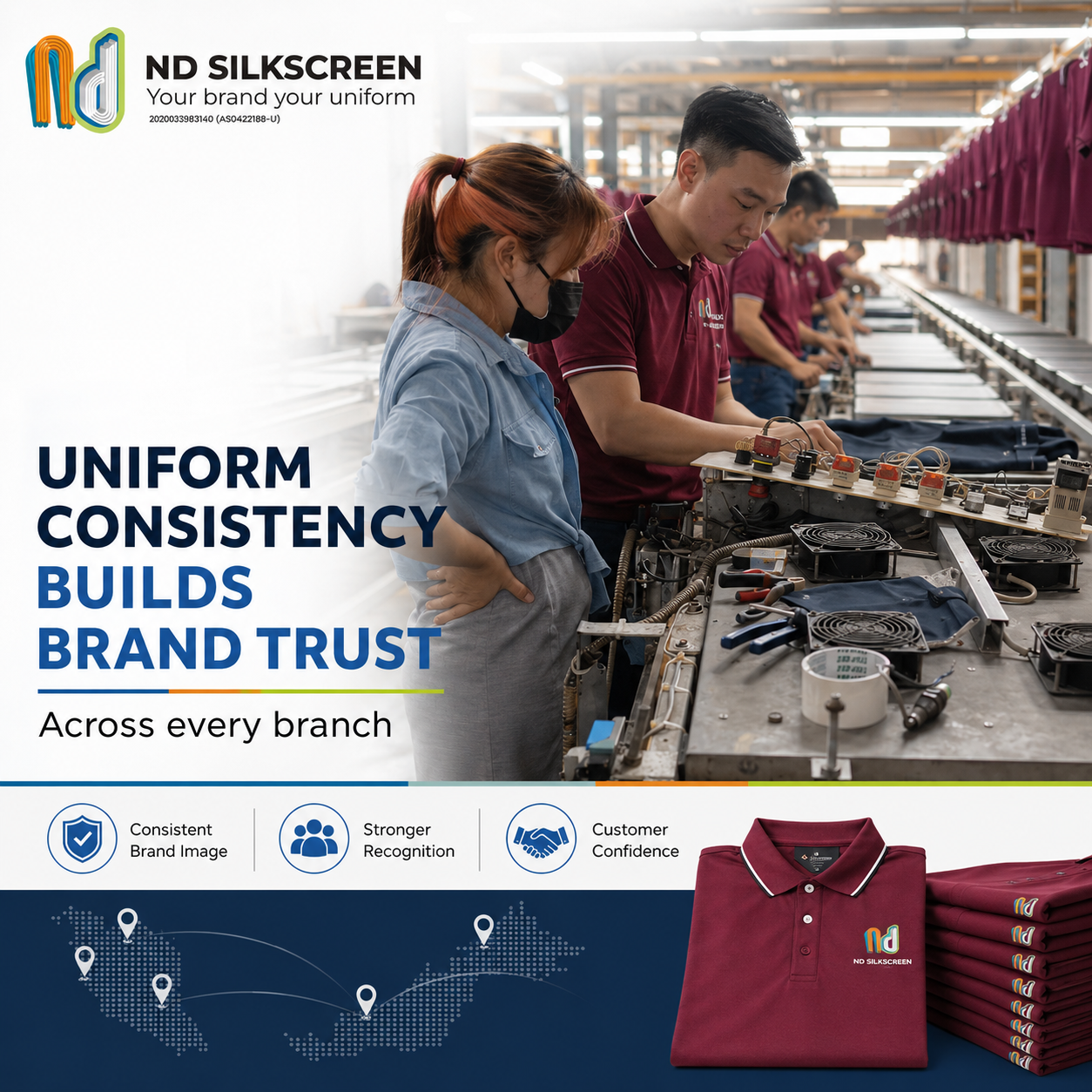
For businesses with multiple branches, visual consistency plays an important role in customer trust. Customers expect the same professional appearance, branding, and service standards regardless of which location they visit.
When staff uniforms differ in colour, logo sizing, fabric quality, or printing consistency, the brand may appear less organized and less reliable. Over time, these inconsistencies can weaken brand recognition and customer confidence across branches.
| Inconsistency Issue | Brand Impact |
|---|---|
| Different logo sizes | Makes branding look uncontrolled |
| Mismatched company colours | Weakens brand recognition |
| Different fabric quality | Creates uneven staff appearance |
| Inconsistent embroidery or printing | Reduces professional image |
| Different uniform designs | Makes branches feel disconnected |
Businesses that manage standardized company uniform printing are usually better positioned to protect visual consistency across locations.
A brand becomes memorable through repeated visual consistency. When customers see the same colours, logo placement, and uniform style across different branches, they are more likely to recognize and trust the company.
When one branch uses different shirt materials, another uses slightly different logo placement, and another has a different printing finish, the brand identity becomes diluted. Customers may not immediately notice every detail, but the overall presentation can feel less unified.
This is especially important for retail chains, restaurants, logistics companies, healthcare providers, franchise businesses, and corporate service providers.
Customers often form impressions within seconds. Uniform inconsistency can make a business appear poorly managed, less established, or visually disorganized.
This does not always mean the company has poor service. The issue is perception. When staff presentation looks inconsistent, customers may assume the company’s internal standards are also inconsistent.
A franchise business operating across several states may experience branding inconsistency when different branches reorder uniforms separately using different suppliers or artwork files. Over time, small differences in fabric shade, embroidery size, and logo placement can make the same brand look different from one location to another.
Many businesses reduce this issue through better uniform reorder management, especially when planning future production batches.
Customers expect established brands to look consistent everywhere. When staff presentation changes noticeably from one branch to another, customers may question whether the branches are officially connected or whether the quality standards are the same.
A consistent uniform system helps a company appear reliable, scalable, and professionally managed. It also gives customers a clearer sense of familiarity whenever they visit a different outlet, office, or service location.
For this reason, many growing companies use company uniform printing Malaysia solutions that support long-term brand control instead of one-off uniform production.
Uniform consistency does not only affect customers. It also affects employees.
When different branches wear noticeably different uniforms, staff may feel less connected to the wider company. Consistent uniforms help build team identity, promote equality, strengthen company culture, and reinforce pride in representing the same brand.
For growing businesses, this internal unity matters because employees should feel they represent one organization, not separate disconnected locations.
Many uniform problems appear during repeat orders. A company may order uniforms again months later and receive slightly different fabric, logo sizing, colour tone, or cutting.
This usually happens when specifications are not documented properly or when production is handled by different suppliers.
Businesses can reduce this risk by working with suppliers that understand in-house uniform production, quality control, and repeat-order consistency.
Before ordering uniforms across multiple locations, businesses should standardize important details such as company colours, fabric type, logo file format, embroidery size, printing placement, shirt cutting, and reorder specifications.
Different departments may need different uniform styles. Office staff, operations teams, event crews, and technical workers may not wear the exact same apparel, but the colours, logo placement, and finishing quality should still feel connected under one brand identity.
Depending on the fabric, role, and durability needs, businesses may compare silkscreen printing services, embroidery services, and sublimation shirt printing Malaysia to maintain consistent branding across different uniform types.
A reliable uniform supplier should help businesses maintain consistency beyond the first order. Important factors include centralized production, fabric knowledge, artwork control, colour matching, repeat-order records, quality inspection, and scalable support for future expansion.
Some Malaysian uniform suppliers now focus on in-house production systems such as ND Silkscreen Trading to maintain repeat-order consistency, colour control, and branding accuracy for long-term corporate clients.
This approach is useful for franchise businesses, multi-location SMEs, expanding retail chains, corporate groups, hospitals, schools, and organizations that need stable uniform supply across Malaysia.
Uniform consistency plays an important role in customer trust, employee identity, and long-term brand recognition across multiple branches. Small differences in colour, logo quality, fabric, or printing can gradually weaken how professional and reliable a business appears.
As Malaysian businesses continue expanding across locations, standardized uniform management is becoming increasingly important for maintaining strong and consistent brand presentation.