
 By Song Jingwoo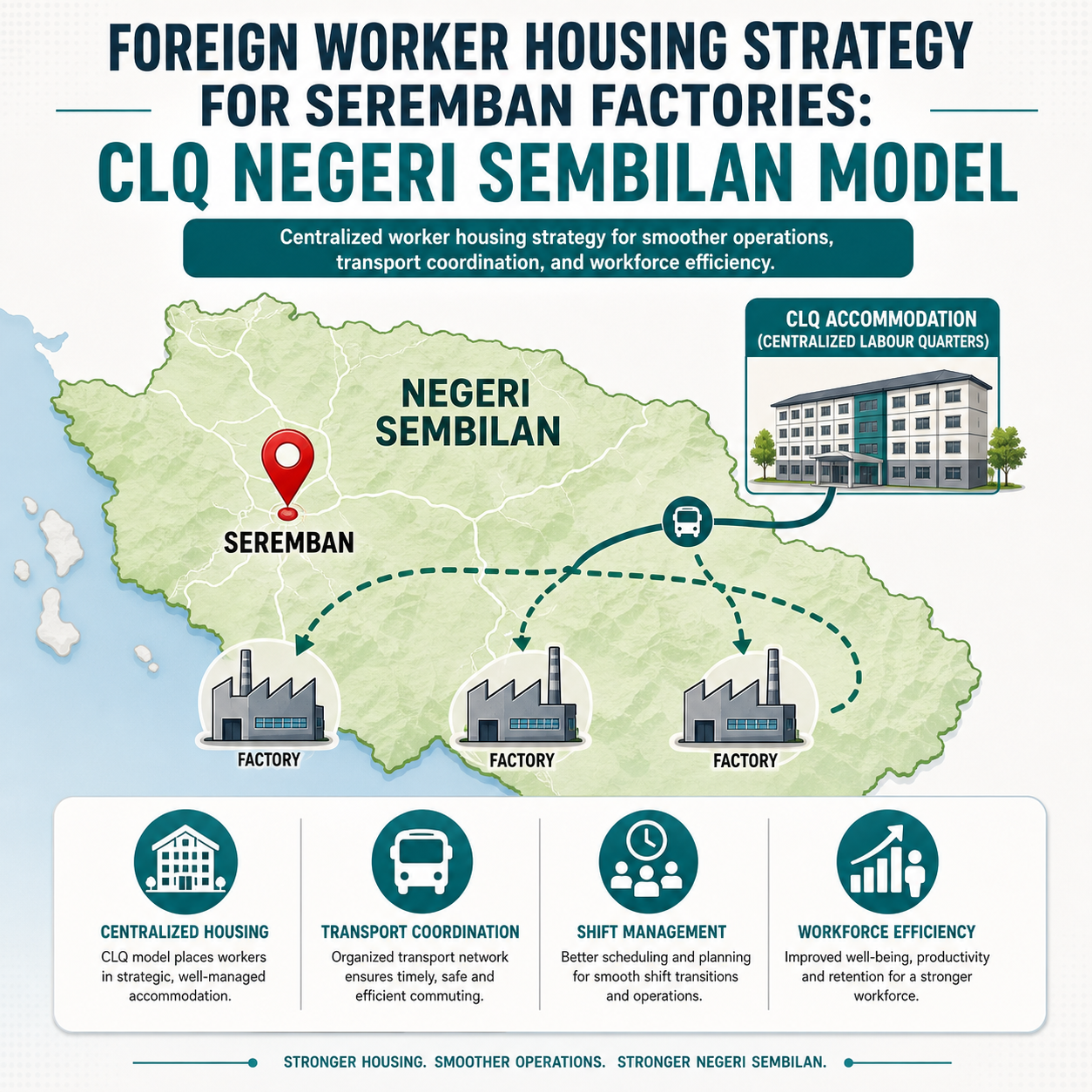
For factories in Seremban, foreign worker housing has evolved into a critical component of operational strategy. It is no longer treated as a basic necessity, but as a system that directly impacts workforce stability, production efficiency, compliance readiness, and cost control.
Many manufacturers are now exploring CLQ Negeri Sembilan worker hostel solutions as a structured way to manage foreign worker accommodation. As industrial zones continue to expand, this model provides a more controlled and scalable alternative to fragmented housing setups.
A growing number of manufacturers are adopting a centralized housing strategy using Nilai as a hub to support operations across Seremban industrial zones. This model combines lower land costs in Nilai with strong highway connectivity to factories in Seremban.
Instead of maintaining scattered housing units, workers are placed in a single, well-managed location and deployed efficiently to multiple factory sites. This approach is now commonly associated with CLQ near Seremban, where centralized labour quarters are designed to support both operational flow and compliance requirements.
As industrial demand continues to grow in Negeri Sembilan, more factories are moving away from scattered housing toward centralized CLQ models. Employers seeking structured solutions often turn to foreign worker accommodation Malaysia solutions that align housing with workforce logistics.
Modern workforce planning in Seremban factories increasingly relies on cluster-based allocation. Workers are grouped based on factory location, shift schedules, and job functions, allowing for more structured deployment.
This system ensures that transport routes are optimized, reducing unnecessary travel time and improving punctuality. For employers managing multiple facilities, it creates a more predictable and efficient manpower structure, especially when supported by centralized worker hostel Seremban arrangements.
Transportation plays a direct role in factory output. A well-planned system aligns worker movement with production shifts, including morning, evening, and night operations.
Dedicated buses, buffer timing, and backup transport solutions ensure that workers arrive on time and that shift transitions remain smooth. For factories relying on tight production schedules, this significantly reduces downtime and improves overall operational reliability.
When workers are housed centrally, attendance monitoring becomes more efficient. Supervisors can verify attendance before shifts begin, identify absenteeism early, and arrange replacements quickly.
Compared to fragmented housing setups, centralized foreign worker accommodation Seremban provides better visibility over workforce movement. This enables more accurate planning and minimizes disruptions to production lines.
Regulatory compliance remains a major concern for employers managing foreign workers in Malaysia. Centralized housing solutions are designed to meet Act 446 requirements, including structured accommodation, hygiene standards, safety protocols, and controlled security systems.
This reduces audit risks while supporting ESG requirements and long-term operational stability. Employers implementing foreign worker accommodation Seremban strategies increasingly prioritize providers that integrate compliance into daily operations.
Security infrastructure such as CCTV and 24-hour monitoring systems further strengthens both compliance and worker safety.
Worker welfare is directly linked to productivity, particularly in shift-based manufacturing environments. Centralized housing typically includes facilities such as cafeterias, recreational areas, and health support services.
These features help improve rest quality, reduce fatigue, and lower turnover rates. Employers managing worker hostel Seremban operations benefit from improved workforce stability when welfare is consistently maintained.
Support services such as health services with quarantine rooms and in-house clinics and cafeteria services for foreign workers contribute to a more sustainable workforce environment.
As industrial activity in Seremban increases, factories require housing solutions that can scale with workforce demand. Centralized accommodation allows for faster onboarding, flexible workforce adjustments, and reduced dependency on sourcing new housing units.
This scalability is especially important for companies experiencing seasonal demand or rapid expansion. In contrast, fragmented housing systems often struggle to keep up with operational changes.
The cost of foreign worker housing extends beyond rental expenses. Employers must also consider transport inefficiencies, HR coordination time, compliance penalties, and productivity losses due to absenteeism.
By integrating housing with workforce logistics, centralized models provide more predictable and optimized operational costs. This makes them a strategic investment rather than a passive expense.
For many manufacturers, the shift toward centralized foreign worker accommodation Seremban is driven by the need for better control, compliance, and efficiency. Models built around CLQ near Seremban offer a structured approach that aligns housing directly with factory operations.
Employers operating in Seremban industrial areas can explore CLQ Negeri Sembilan worker hostel solutions that provide centralized housing, transport coordination, and compliance-focused accommodation designed specifically for factory operations.