
 By Song Jingwoo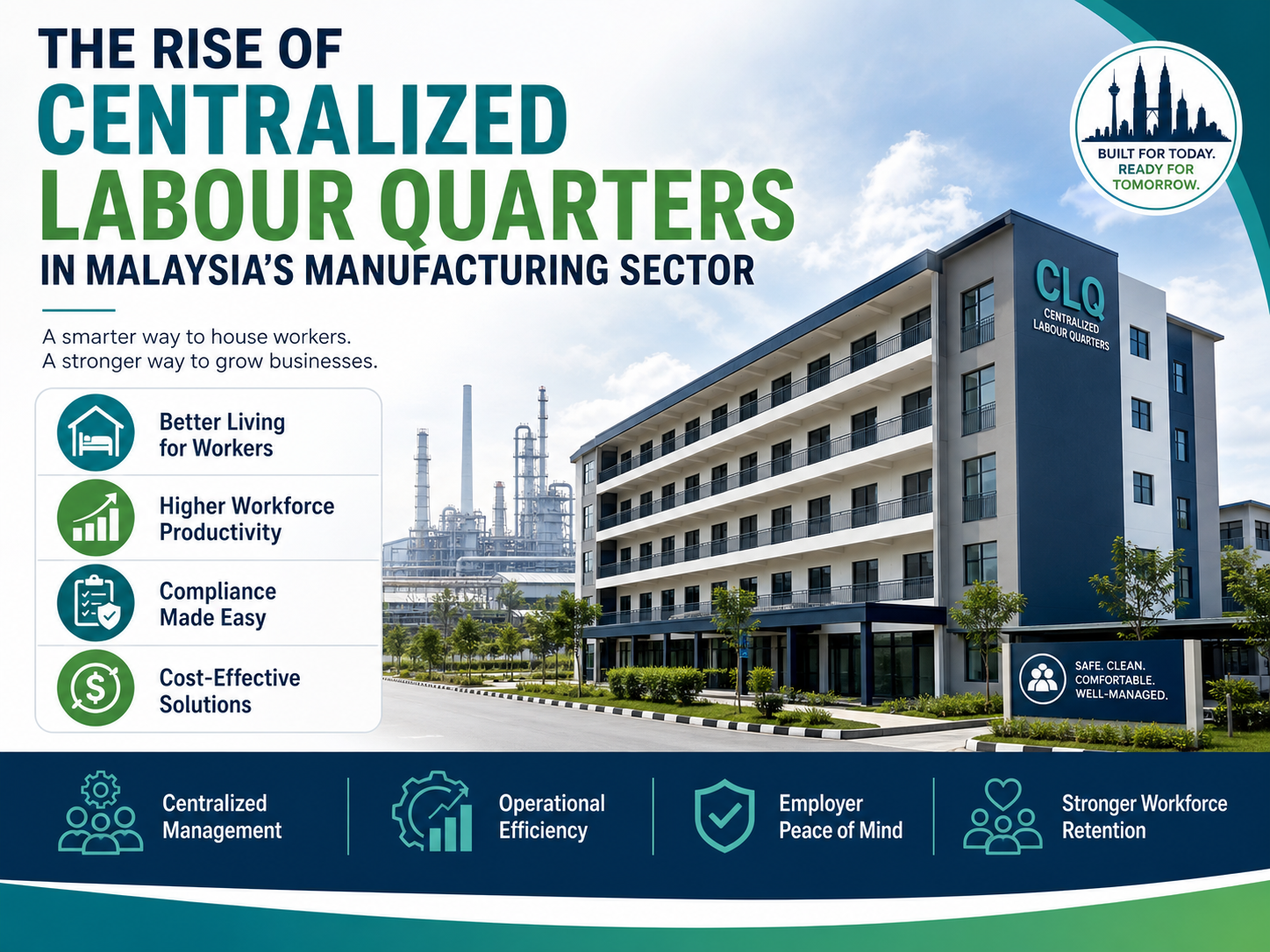
Malaysia’s manufacturing sector is undergoing a structural shift in how foreign worker accommodation is managed. Traditional housing models—such as scattered shoplots, rented terrace houses, and fragmented hostels—are increasingly being replaced by Centralized Labour Quarters (CLQs).
This shift is also driving increased demand for foreign worker accommodation Malaysia solutions, particularly structured CLQ models that support both compliance and workforce efficiency.
Many manufacturers are now exploring CLQ Negeri Sembilan worker hostel solutions as a structured way to manage foreign worker accommodation while improving workforce control and long-term efficiency.
The rise of CLQs reflects a broader transformation in how companies view worker housing—not as a cost center, but as a strategic operational system. Across Malaysia, more manufacturers are transitioning from scattered housing to centralized labour quarters to improve compliance and operational control.
Malaysia’s enforcement of Act 446 has significantly changed employer responsibilities. Companies are now required to provide proper, licensed, and compliant accommodation for foreign workers.
This has made informal housing arrangements increasingly risky. Employers must now ensure that housing meets standards related to space, hygiene, safety, and documentation. Many are turning to structured solutions such as the CLQ Negeri Sembilan Act 446 compliance guide to reduce legal exposure and maintain audit readiness.
Manufacturers operating around the clock require reliable workforce coordination. Attendance consistency, smooth shift transitions, and predictable manpower availability are critical to maintaining production output.
A managed accommodation model enables better control over these variables. Workers can be deployed systematically, and transportation can be aligned with shift schedules, improving punctuality and reducing operational disruptions.
Global clients are placing greater emphasis on Environmental, Social, and Governance standards. Worker accommodation is now part of audit evaluations, particularly for export-oriented manufacturers.
Companies must demonstrate that workers are housed in safe, clean, and regulated environments. CLQs provide a structured way to meet these expectations while strengthening brand credibility and client trust.
Fragmented housing often leads to hidden costs, including inefficient transport routes, increased HR workload, higher absenteeism, and compliance risks.
An integrated housing system reduces these inefficiencies by consolidating workforce management into a single operating structure. As a result, total operational costs become more predictable and easier to control.
As CLQs become the industry standard, the difference lies in how these facilities are designed and managed. LG Solution (M) Sdn Bhd offers more than accommodation—it delivers a fully integrated workforce ecosystem.
Unlike providers that only offer basic lodging, LG Solution integrates accommodation with transport, meals, welfare, and security into one coordinated system.
This includes facilities such as cafeteria services for foreign workers, ensuring consistent meals, and professional counselling and consultation support, which helps maintain worker well-being.
The result is a single, structured system that simplifies workforce management for employers.
LG Solution’s model is built specifically for industrial environments. It supports shift-based operations, high worker volume, and multi-factory deployment.
This makes it particularly suitable for electronics manufacturers, logistics hubs, and export-driven factories that require stable and scalable workforce systems.
Located in Nilai, LG Solution benefits from strong connectivity to key industrial regions including Seremban, Kuala Lumpur, and Selangor.
This strategic positioning allows for faster worker deployment, reduced travel time, and lower transportation costs. Employers benefit from a regional hub that supports manufacturing operations efficiently.
Compliance is built into the foundation of LG Solution’s housing model. Facilities are designed to meet Act 446 standards, with structured accommodation layouts, hygiene protocols, and monitored environments.
Security features such as CCTV and 24-hour monitoring systems and controlled access points enhance both safety and compliance readiness. These measures help companies pass audits, reduce legal risks, and maintain long-term operational stability.
A structured housing model improves workforce visibility and control. Attendance can be monitored before shifts begin, allowing supervisors to identify issues early and reassign workers when necessary.
Transport systems are synchronized with shift schedules, ensuring smoother transitions and reducing delays. This leads to improved punctuality, lower absenteeism, and more stable production output.
While CLQ housing may not always appear to be the lowest upfront cost, it delivers long-term savings by reducing inefficiencies across operations.
Employers benefit from lower transport costs, reduced HR coordination, fewer compliance risks, and improved worker retention. This creates a more sustainable cost structure over time.
As manufacturing demand increases, companies need housing solutions that can scale with workforce expansion. CLQs allow for rapid onboarding of new workers without the need to secure additional housing locations.
This scalability supports long-term growth while maintaining clear control over workforce management.
The rise of Centralized Labour Quarters in Malaysia reflects a broader evolution in the manufacturing sector. Companies are moving away from fragmented housing toward integrated systems that align accommodation with operational needs.
For employers evaluating long-term strategies, CLQs offer a practical solution that combines compliance, efficiency, and scalability.
Manufacturers seeking to improve workforce control, compliance, and operational efficiency can explore foreign worker accommodation Malaysia solutions, including CLQ Negeri Sembilan worker hostel models, designed for modern industrial operations.